What is the meaning of that finger in the air? You watch the match, and suddenly the official raises a hand high while the entire crowd erupts in loud cheers. You nod along, pretending you fully understand what just happened on the field. Truthfully, you might confess that you do not know every single call and motion yet.
These gestures build the visual code that keeps the action moving smoothly. Also, players closely observe every move from the official, and the scorers quickly log each motion into the live record. Overall, fans in the stands and viewers at home follow those same cues.
Moreover, this guide gives you that exact knowledge in plain, everyday terms. Below, you will find all the major cricket umpire signals explained in simple words with zero confusing jargon and no heavy rulebooks. Furthermore, every question gets a clear answer so anyone can follow along easily, whether you have watched for decades or just tuned into a couple of matches this season.
Why Umpire Signals in Cricket Matter
Consider the electric atmosphere inside the stadium on match day. Also, the roar of the cheering crowd echoes everywhere. Overall, a bowler sprints down the run-up and releases the delivery. In addition, action unfolds right near the crease, and every single person looks straight at the official. Officials must make instant judgments that shape the entire outcome of the contest. Because they cannot yell across the noisy ground every time, they rely on clear cricket umpire signals to communicate. Furthermore, every gesture stays completely consistent and follows the official MCC Laws of Cricket.
This visual language keeps the official scorers accurate at all times. Players watch those exact movements to know what just happened on the pitch. Overall, fans and supporters watching from the stands also rely on those clear cues. Missing out on this silent code often confuses during intense moments. Learning it helps you follow the action smoothly, even in the tightest situations.
The Complete Cricket Umpire Hand Signals Breakdown
Time to walk through the signals one by one. Also, this cricket umpire hand signals guide covers scoring calls, extras, dismissals, and match control. Overall, each gesture carries one clear meaning.
Scoring and Boundary Signals
These signals confirm runs when batters don’t need to run them out. Moreover, they also cover extras.
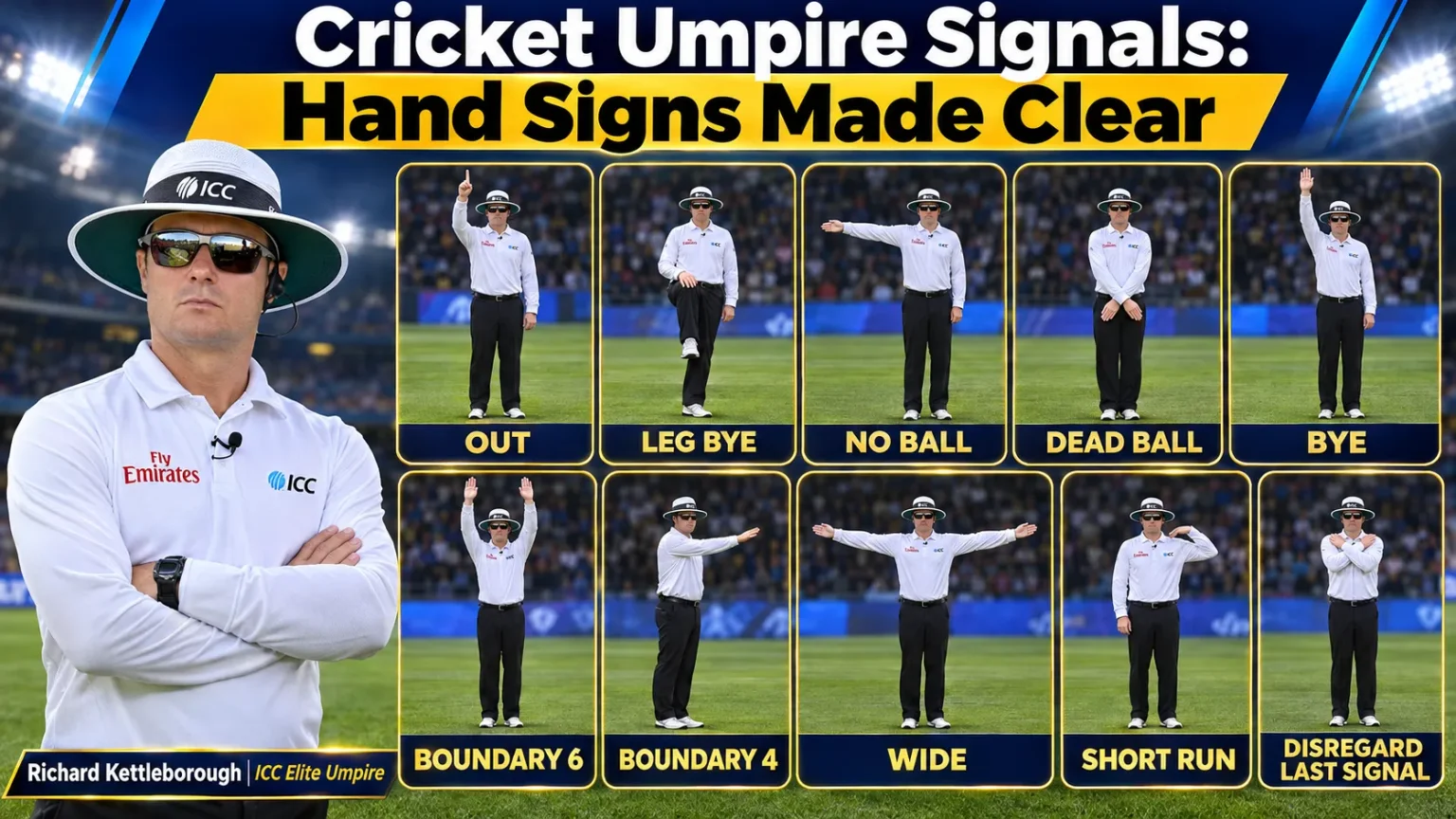
Four Runs: The umpire sweeps one arm back and forth across the chest. Also, the ball hit the ground before crossing the rope. Four runs added.
Six Runs: Both arms rise straight above the head. In addition, the ball cleared the rope without bouncing. Likewise, six runs for the batting side.
Bye: Among the standard cricket umpire signals, one open hand lifted straight above the head means the ball passed the batter without touching the bat or body, and runs were taken.
Leg Bye: The umpire lifts one knee and taps it with a hand. Also, the ball rolled off the batter’s body, not the bat, and runs were completed.
Short Run: One arm bends up, fingers touching the near shoulder. Moreover, a batter didn’t ground their bat behind the popping crease. Overall, one run comes off the total.
Extras and Illegal Delivery Signals
These specific cricket umpire signals point out bowling mistakes and usually lead to bonus runs for the batsmen, as well as a re-bowl.
Wide Ball Signal in Cricket: The umpire spreads their hands to either side, forming a T shape. Also, it signifies that the delivery was thrown too wide or too high for a standard shot. Moreover, the batting side receives one extra run plus whatever the batsmen manage to score.
No Ball Signal in Cricket: One arm is stretched out straight at the shoulder level. It implies that the bowler has broken a rule of cricket, such as running across the crease or bowling a waist-high full toss. Usually, an extra run is scored by the team, and a free hit is awarded in limited-overs cricket.
Free Hit: The umpire circles one index finger above the head. This comes right after a no-ball in white-ball cricket. In addition, the batter can’t be dismissed on the next ball unless they get run out, hit the ball twice, or block the field.
Dead Ball: Both wrists cross and uncross below the waist. Moreover, play stops cold. No runs, no dismissals, until the bowler starts the next run-up.
Dismissal Signals and Reviews
These crucial cricket umpire signals end an innings, pause play, or handle unfair play, with the out signal in cricket standing as the most famous of the bunch.
Out Signal in Cricket: One index finger points straight up. Also, the batter is out, whether by LBW, catch, stumping, or bowled. Off the field they go.
Not Out: The umpire shakes their head or keeps the finger down. Sometimes the palms face down too. The appeal fails, and the batter stays in.
TV Replay / Third Umpire: Both hands draw a big rectangle in the air, like a TV screen. A tight call goes upstairs to the third umpire.
Player Review (DRS): Both forearms cross in front of the chest, forming a “T.” A player has asked for a Decision Review System check.
Cancel Call / Revoke: Among various cricket umpire signals, the cancel call or revoke gesture involves the umpire crossing both arms over the chest and touching each shoulder with the opposite hand, which wipes out an earlier signal made by mistake.
Cricket Signals Chart for Match Administration
Modern cricket also runs on clear cricket umpire signals for replays, substitutions, and timekeeping. Overall, this comprehensive cricket signals chart section covers those essential housekeeping gestures, and breaks each one down so fans never miss a call.
Penalty Runs (Batting): One hand rests on the opposite shoulder. Five penalty runs go to the batting team after a fielding infraction.
Penalty Runs (Fielding): The umpire taps one shoulder with the opposite hand. Five penalty runs go to the fielding team for wasted time or deliberate short running.
New Ball: The umpire lifts the fresh ball toward the scorers and pavilion. A replacement ball is in play, normally after 80 overs in Test cricket.
Powerplay / Fielding Restriction: One arm swings in a big vertical circle. The powerplay phase begins in ODI or T20 cricket.
Last Hour: The umpire taps a wrist like checking a watch. The final hour of play starts on the last day of a test.
Impact Player / Concussion Sub: Arms cross overhead in an “X.” A tactical or medical substitution is confirmed.
Soft Signal (Historical Note): Previously, cricket umpire signals included pointing a finger to the side before the TV review of a catch, though the ICC cancelled this soft signal in 2023.
Quick Reference: Cricket Signals Chart Summary
Keep this helpful cricket umpire signals table handy during matches. It sums up the key gestures at a glance.
| Signal | Gesture | Meaning |
| Four Runs | Sweep one arm across the chest. | The ball crossed the boundary after touching the ground |
| Six Runs | Both arms straight up | The ball cleared the boundary on the full. |
| Bye | One open hand above head | The ball passed the batter without contact. |
| Leg Bye | Lift the knee and tap it. | The ball deflected off the batter’s body |
| Wide Ball | Both arms out horizontally | Delivery too wide for a normal shot |
| No Ball | One arm straight out | Illegal delivery by the bowler |
| Out | The index finger points up | Batter dismissed |
| Dead Ball | Cross and uncross wrists | Play stopped |
| TV Replay | Draw a rectangle in the air | The decision was sent to the third umpire |
Final Thoughts
The understanding of cricket umpire signals changes the perception of the game dramatically. Every sign has a certain purpose and tells something about the game. Likewise, umpires direct the game using only their hands and arms.
Next time you tune in, keep one eye on the umpire. Also, you’ll catch these signals everywhere. You’ll call decisions before the commentators say a word. That’s what this visual language gives you. On top of that, you’ll respect the officials who keep cricket fair and flowing.
Want to test your cricket knowledge? Enter the Starexch blog and find fans who live for this game. Take a look at the guides and sharpen your knowledge. The field is waiting for you. Read it!